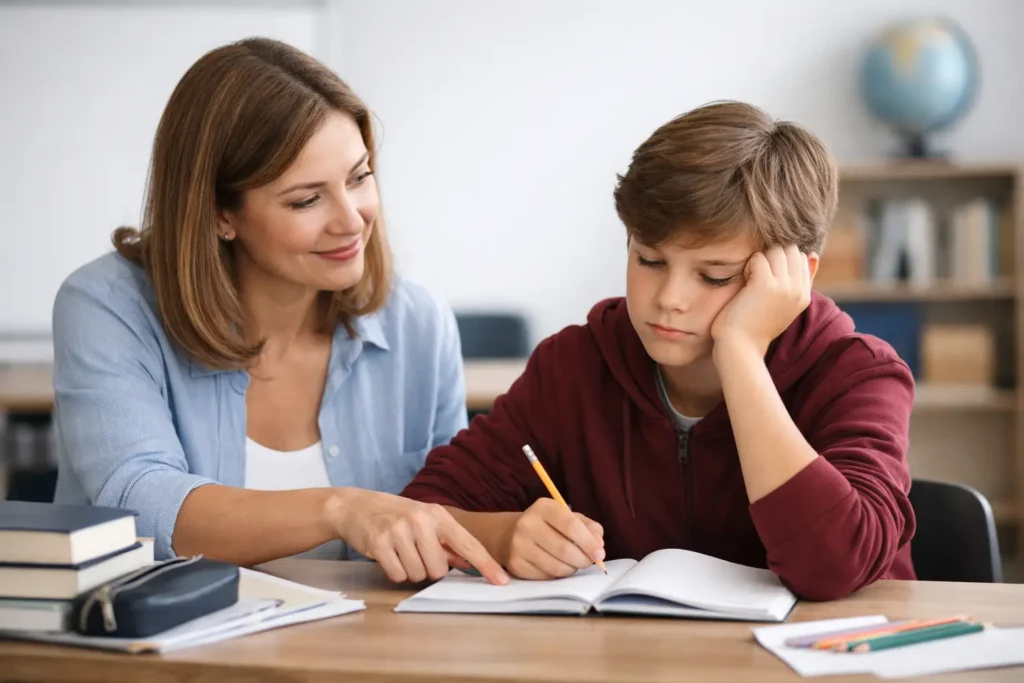
A student who shuts down after the first hard question is not simply refusing to try. A student who looks distracted during reading may be carrying a skill gap, low confidence, stress, or all three. Effective classroom success strategies for struggling students start with that reality: when learners fall behind, the barrier is rarely academic in only one way.
Schools see this every day. Students need help with decoding, number sense, writing stamina, and content understanding. They also need support with routines, self-management, confidence, and the belief that effort can still lead somewhere. When classroom support addresses both learning recovery and readiness, students are far more likely to re-engage and make measurable progress.
Why classroom success strategies for struggling students must go beyond remediation
A narrow intervention model often assumes that more practice alone will solve the problem. Sometimes it helps. Often, it does not. A student can receive extra worksheets in math and still avoid participating because they are embarrassed to be wrong in front of peers.
That is why schools need a broader response. Academic intervention matters, but it works best when paired with consistent classroom expectations, strong relationships, and structures that make progress visible. Students who struggle need access to grade-level learning, not permanent assignment to watered-down work. At the same time, they need targeted support that meets them where they are.
The trade-off is real. If support is too far below grade level, students can lose momentum and exposure to core standards. If support is too advanced without scaffolding, frustration rises and behavior often follows. The most effective classrooms hold both truths at once: maintain high expectations and reduce unnecessary barriers.
Start with a clearer picture of what the student is facing
Before choosing an intervention, educators need to identify the actual obstacle. A student who is missing assignments may have weak executive functioning, limited reading stamina, unstable attendance, or confusion about directions. Those situations do not call for the same response.
Useful classroom decisions come from simple, actionable evidence. Look at work samples. Notice when the student disengages. Compare independent performance with guided performance. Ask what happens before the student shuts down, acts out, or withdraws. Brief check-ins with families and support staff can also reveal patterns that are not visible during one class period.
This does not require a lengthy evaluation cycle for every concern. It does require discipline. When adults move too quickly to label a student as unmotivated, they often miss the chance to solve the right problem.
Look for academic and readiness signals together
A learner may read below grade level and also struggle to start tasks without prompting. Another student may understand the lesson verbally but cannot organize written responses. These are different needs, and both affect classroom performance.
The strongest support plans name the academic target and the readiness target. For example, a student might need fluency practice in reading and a predictable start-of-class routine. Another might need small-group math support and short self-monitoring checkpoints to stay on task. When those pieces work together, classroom improvement becomes more realistic and more sustainable.
Build safety and predictability before expecting persistence
Students who have experienced repeated difficulty often assume another failure is coming. In practice, that means they may rush, avoid, joke, argue, or go silent. Teachers can reduce that threat response by making the classroom more predictable.
Predictability is not about lowering rigor. It is about making the path into learning clear. Post and repeat routines. Break directions into manageable steps. Show what a strong response looks like. Let students know what happens if they get stuck. A calm, consistent environment lowers the emotional cost of trying.
This is especially important for students recovering from interrupted learning or long periods of disengagement. They are often assessing whether the classroom is a place where mistakes are part of growth or proof that they do not belong.
Use feedback that protects dignity
Struggling students usually receive more correction than affirmation. Over time, that shapes identity. Feedback should still be honest, but it must point to action. “You’re careless” closes a door. “Your first step is correct. Now let’s line up the decimals” gives the student a next move.
Specific praise matters here too, especially when tied to effort, strategy, or improvement. Empty encouragement wears thin. Students can tell the difference between generic positivity and evidence that an adult noticed something real.
Make grade-level learning accessible with strong scaffolds
One of the most common mistakes in intervention-heavy classrooms is replacing meaningful work with easier work that does not build toward core standards. Students may feel temporary relief, but the long-term result is wider gaps.
A better approach is to keep students connected to grade-level content while adjusting the support. That can mean pre-teaching vocabulary, chunking text, offering sentence frames, modeling one example before independent practice, or using guided notes. In math, it may mean worked examples, visual models, and fewer problems with deeper discussion rather than a page of repetitive tasks.
Scaffolds should help students do the thinking, not remove the thinking. If support becomes so heavy that the adult carries the cognitive load, students remain dependent. If support is too light, they stall. The balance depends on the student, the content, and the level of prior unfinished learning.
Prioritize small wins that students can see
Students who are behind often have a weak sense of progress. They know they are struggling, but they do not always see improvement in a way that feels concrete. That is why visible, near-term wins matter.
A student may not move from below grade level to proficiency in a few weeks, but they can complete the first five minutes of independent work without prompting. They can revise one paragraph using a checklist. They can improve multiplication fact accuracy from one set to the next. These wins are not minor. They are often the bridge to larger academic recovery.
Teachers can make progress visible through short goal-setting cycles, simple trackers, and regular reflection. The point is not public comparison. The point is helping students connect effort to evidence.
Strengthen student readiness, not just subject performance
Academic performance is shaped by habits and self-management. A student who loses materials, forgets deadlines, or cannot regulate frustration may appear less capable than they are. Classroom support should account for that.
This is where routines, cues, and coaching become part of instruction. Some students need a consistent way to begin work. Some need help breaking long tasks into parts. Others need language for asking for help before they give up. These are teachable skills, not side issues.
In many high-need settings, readiness support is not extra. It is foundational. Confidence, attention, and persistence influence whether intervention time produces results. That is one reason organizations like IUME Foundation focus on both standards-aligned learning support and whole-child readiness factors. Schools need practical, measurable support for the students who need it most, and that support has to reflect how students actually learn.
Use time and staffing strategically
Schools rarely have unlimited capacity. Teachers are balancing large class sizes, varied needs, and pressure to improve outcomes quickly. That makes prioritization essential.
High-impact strategies are usually simple enough to implement consistently. Small-group instruction during a protected block can be more effective than sporadic pull-outs. Shared intervention routines across classrooms can reduce confusion for students. Targeted volunteer support can help when it is well-trained and aligned to clear goals, but it works best as reinforcement, not as a substitute for instructional planning.
There is no single staffing model that fits every campus. What matters is coherence. Students make stronger gains when adults are working from the same goals, using similar language, and tracking progress in ways that inform next steps.
What effective support looks like over time
The first sign of progress is not always a test score. Sometimes it is attendance improving, work completion rising, or a student taking a risk they used to avoid. Those shifts matter because they often come before stronger academic outcomes.
Over time, effective classroom support should produce both engagement gains and skill gains. Students begin tasks more independently. They tolerate challenge longer. They can explain what strategy helped them. They improve in the specific academic areas that were targeted. If one side is missing, the plan may need adjustment.
That adjustment is part of the work. Some students need more intensive support than a classroom teacher alone can provide. Some need family partnership to stabilize routines outside school. Some need a different intervention because the first one was not a good match. Responsive schools do not treat that as failure. They treat it as implementation discipline.
Classrooms change when struggling students stop being seen as problems to manage and start being supported as learners with unfinished skills, real strengths, and the ability to grow. The most effective strategies are not flashy. They are consistent, humane, and focused on what moves student progress forward one clear step at a time.