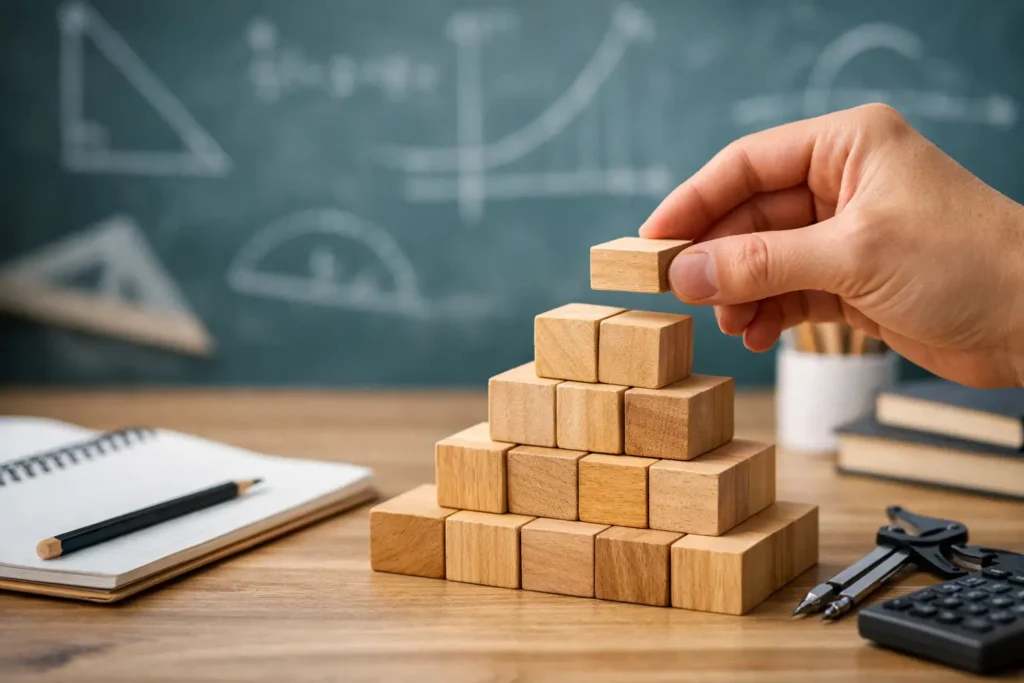
A student who misses one key idea in math can carry that gap for years. Trouble with place value can become trouble with multi-digit computation. Weak fraction sense can make ratios, algebra, and data analysis feel impossible. Knowing how to rebuild math foundations is not about asking students to repeat an entire grade level. It is about identifying the few prerequisite skills that are blocking progress, then providing focused practice, clear instruction, and the confidence to keep trying.
For schools serving students affected by interrupted learning, mobility, absenteeism, or limited access to academic support, math recovery must be both urgent and humane. Students need practical, measurable support for the skills in front of them. They also need to believe that improvement is possible.
Start With the Skill, Not the Label
Terms such as “below grade level” can describe a need, but they do not explain it. Two students who earn the same low score may need very different support. One may understand the concept but make calculation errors. Another may lack the vocabulary to interpret word problems. A third may avoid beginning because past frustration has taught them to expect failure.
A useful first step is a short diagnostic conversation and a low-stakes skills check. Focus on the math that current classroom work requires. If a sixth grader is struggling with ratios, assess fraction equivalence, multiplication facts, division, and interpreting quantities before assigning a broad packet of sixth-grade review.
This approach protects instructional time and student dignity. The goal is not to catalog every unfinished skill. It is to find the most important next skill and teach it well.
Look for prerequisite chains
Math learning is cumulative, but not every gap has equal weight. Schools and educators can map a struggling standard backward to the concepts that support it. For example, difficulty solving equations may point to gaps in integer operations, the meaning of equality, or inverse relationships.
Use standards-aligned assessments and classroom evidence together. A quiz score alone cannot show whether a student guessed, misunderstood the language, or used an incomplete strategy. Student work samples, brief interviews, and observation during practice often reveal more than another test.
Teach Meaning Before Speed
Students rebuilding foundations need more than rules to memorize. They need to understand what numbers, operations, and symbols represent. Speed can matter later, especially when fluency reduces cognitive load, but speed should not be the first measure of success.
For early number sense, use visual models such as ten frames, number lines, counters, and base-ten blocks. For fractions, connect area models, sets, and number lines before moving quickly to procedures. For algebra, use balance models and real quantities to show why the same operation must happen on both sides of an equation.
Concrete and visual tools are not only for younger learners. An older student may need a fraction strip or a number line without being treated as less capable. The materials should be age-respectful, and the message should be clear: using a model is a mathematical strategy, not a sign of failure.
When students can explain their reasoning in words, pictures, and equations, educators gain a better view of what they know. This also makes it easier to correct misconceptions before they become habits.
Build a Small, Reliable Practice Routine
Math foundations are rebuilt through repeated, successful contact with essential ideas. Long, unfocused worksheets can create the appearance of effort without producing much learning. Short routines, used consistently, are more likely to help students notice patterns and retain skills.
A strong intervention block may include a brief retrieval warm-up, direct instruction on one skill, guided practice with immediate feedback, and a final check for understanding. The exact schedule depends on staffing and the student’s needs, but the sequence matters. Students should recall prior learning, make sense of a new or repaired idea, practice it with support, and show what they can do independently.
Practice should mix familiar and newer skills. If every problem looks the same, students may follow a procedure without deciding which procedure applies. A few carefully chosen mixed problems help students learn to recognize the math itself.
Feedback must be timely and specific. “Check your work” is less useful than “Your model shows three groups of four, but your equation says four groups of three. Which quantity tells us the number of groups?” Specific feedback gives a student a next step rather than a judgment.
Rebuild Math Foundations Alongside Confidence
Academic recovery and student readiness belong together. A learner who has been repeatedly told, directly or indirectly, that they are “bad at math” may hesitate to write anything down, participate in a group, or persist through a challenging problem. That response is understandable. It is also a barrier schools can address.
Educators can make progress visible through attainable goals. Rather than promising that a student will “catch up,” set a concrete target: accurately compare fractions with common denominators, solve ten multiplication facts using a chosen strategy, or explain the steps in a two-step equation. Celebrate growth in strategy use, accuracy, and persistence, not only perfect answers.
Language matters. Replace fixed labels with evidence of learning: “You do not have this skill yet” is more productive than “You are behind.” Ask students to identify what helped when they solved a difficult problem. Over time, they begin to see effort as connected to specific actions, such as drawing a model, checking an estimate, or asking a clarifying question.
This does not mean lowering expectations. It means creating the conditions in which students can meet meaningful expectations. High-quality support combines rigorous grade-level goals with carefully targeted access to prerequisite learning.
Protect Grade-Level Learning While Providing Intervention
One common trade-off in math recovery is time. Students need foundation work, but they also deserve access to the grade-level concepts their peers are learning. Pulling students away from core instruction too often can widen the very gap an intervention is meant to close.
Whenever possible, connect intervention to current coursework. A student practicing multiplication can apply equal groups to area, scaling, or proportional reasoning. A student reviewing negative numbers can use them in coordinate graphs and real-world change over time. These connections help foundational learning feel relevant rather than separate.
The right model depends on the campus schedule, staffing, and intensity of need. Some students benefit from a short daily small group. Others need more frequent tutoring, targeted summer learning, or additional support during an academic recovery period. What should remain consistent is the use of data to adjust support. If a strategy is not helping after a reasonable period, the response should change.
Make the Work a Shared School Commitment
No single teacher can close every learning gap alone. Effective math recovery requires coordination among classroom teachers, interventionists, special educators, instructional leaders, families, and community partners. Each group sees a different part of the student’s experience.
Campus leaders can support implementation by protecting intervention time, selecting a small set of priority skills, and reviewing progress at regular intervals. Educators need usable materials, clear pacing, and opportunities to discuss student work together. Families can help when schools share simple, encouraging ways to practice math at home without turning every evening into a struggle.
Partnership-based programs can expand capacity, particularly in high-need schools. Trained volunteers, tutors, and subject-matter experts can reinforce teacher-led plans when they use consistent methods and understand the school’s learning goals. Responsible technology can also provide practice and progress information, but it should support relationships and instruction, not replace them.
At IUME Foundation, this whole-child approach guides the work of making quality learning within reach for every child. Math recovery is stronger when academic support is paired with the habits, confidence, and engagement students need to use that support.
Measure Progress in Ways Students Can See
Progress monitoring should be frequent enough to guide instruction but light enough to preserve teaching time. A two- or three-question exit ticket, a brief oral explanation, or a weekly skill check can show whether students are ready to move forward.
Track more than correctness when possible. Notice whether a student begins work independently, chooses an appropriate strategy, explains an error, or persists after feedback. These readiness indicators do not replace academic measures, but they help adults understand why a student may or may not be progressing.
Share evidence of growth with students. A simple record showing that they can now solve problems that felt out of reach a month earlier can be powerful. It turns recovery from an adult plan happening around them into work they can recognize as their own.
The next right math lesson does not need to solve every gap at once. It needs to give a student one clear idea, one workable strategy, and one real reason to believe that progress is within reach.