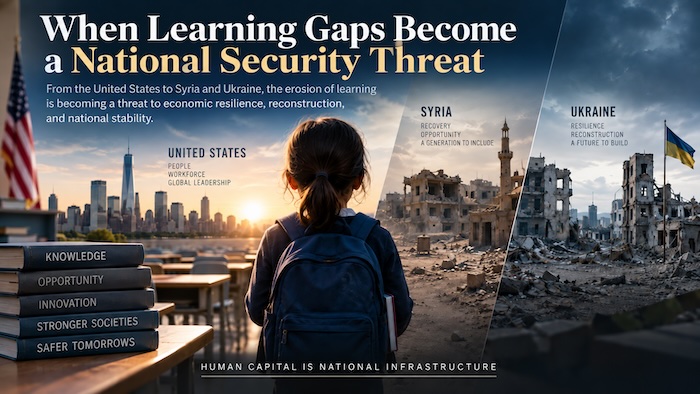
From the United States to Syria and Ukraine, the erosion of learning is becoming a threat to economic resilience, reconstruction, and national stability.
National security rarely begins in a classroom. But it can fail there.
We normally think of national security in terms of armies, borders, energy, technology, intelligence, and economic strength. Education is usually placed somewhere else—in the category of social policy.
Yet every one of those traditional pillars of national security ultimately depends on human capability: people who can read, reason, calculate, build, repair, invent, manage, communicate, and adapt.
When large learning gaps accumulate across a generation, a country is therefore doing more than failing individual students. It is weakening its future workforce, productive capacity, technological competitiveness, social mobility, and ultimately its resilience as a nation.
The United States provides a useful place to begin, precisely because it demonstrates that this process does not require a war.
America’s Slow-Moving Learning Crisis
The United States still possesses extraordinary universities, research institutions, companies, and technological capabilities. It remains one of the world’s greatest magnets for talent. But underneath that strength, weaknesses have been developing in the education pipeline.
The 2024 National Assessment of Educational Progress provides one warning. Twelfth-grade reading scores fell three points from 2019 and now stand ten points below their 1992 level. Twelfth-grade mathematics also declined from 2019. Among younger students, the picture is increasingly uneven: eighth-grade mathematics performance in 2024 improved among higher-performing students while declining among students at the bottom of the distribution. In other words, averages can conceal an increasingly consequential group of students entering adulthood without strong foundational skills.
The pandemic intensified the problem, but it did not fully explain it. Harvard and Stanford’s Education Recovery Scorecard found that by spring 2024 the average American student remained nearly half a grade level behind pre-pandemic achievement in both mathematics and reading. Reading recovery had actually worsened, and chronic absenteeism was contributing to widening gaps between higher- and lower-poverty communities.
The newly released PISA 2025 results reveal an even more important distinction.
America does not have to collapse in international rankings to be losing ground. U.S. 15-year-olds still performed above the OECD average in reading and science and close to the OECD average in mathematics. Viewed only as a ranking, that may appear reassuring.
But the absolute performance tells another story. American reading and mathematics scores are now below their 2018 levels and are among the lowest ever recorded for the United States in PISA. Compared with 2015, the proportion of low-performing American students increased by six percentage points in mathematics and seven points in reading.
In 2025, only 65 percent of American students reached at least basic Level 2 proficiency in mathematics. Put another way, 35 percent of American 15-year-olds did not. In reading, 26 percent failed to reach that basic level.
At the other end of the spectrum lies another competitive warning. Only 8 percent of U.S. students reached the highest mathematics proficiency levels. That compares with 37 percent in Singapore, 32 percent in Chinese Taipei, 23 percent in Korea, and 22 percent in Japan.
This matters because the next generation of competition between nations will increasingly involve artificial intelligence, advanced manufacturing, semiconductors, biotechnology, aerospace, cybersecurity, robotics, and energy systems—all fields built on sophisticated scientific and mathematical capabilities.
The National Science Board explicitly describes STEM talent as fundamental to U.S. competitiveness and says the STEM workforce is integral to meeting challenges including national security.
There is another reason international rankings can be misleading. PISA 2025 recorded the lowest OECD-average performance yet observed in reading, mathematics, and science. Between 2015 and 2025, average OECD reading performance fell by 28 points—roughly equivalent to a year and a half of learning—while mathematics fell by 22 points, or just over a year.
America can therefore maintain a respectable position relative to other countries while its own students are becoming less prepared, and the problem does not disappear when students leave school.
The OECD’s latest assessment of American adults found that 34 percent scored at or below its lowest numeracy level, compared with 25 percent across participating OECD countries. Twenty-eight percent were at the lowest literacy levels. Most concerning, American adults aged 16 to 24—those closest to the education system—performed below OECD averages in literacy, numeracy, and adaptive problem solving. The gaps between America’s highest- and lowest-skilled adults have also widened over the past decade.
These are not simply education statistics. They are workforce statistics, productivity statistics, competitiveness statistics, and eventually, national-security statistics.
War Compresses the Same Process Into a Generation
If declining educational outcomes can gradually weaken the capabilities of a wealthy and functioning country, prolonged conflict can compress the same process into a single generation.
Schools close. Teachers flee. Families are displaced. Children move repeatedly between education systems—or leave education altogether. Poverty pushes adolescents toward work. Trauma interferes with learning.
Eventually the problem changes character. What began as interrupted schooling becomes a generation reaching adulthood without the capabilities needed to participate fully in its country’s recovery.
Syria: Rebuilding a Country Without the Generation Needed to Rebuild It
Syria’s civil war began in 2011. On December 8, 2024, opposition forces captured Damascus and Bashar al-Assad fled the country, ending almost fourteen years of conflict and more than five decades of Assad-family rule.
The political transition created the possibility of rebuilding Syria, but rebuilding a nation requires more than money and concrete.
More than 75 percent of Syria’s 10.5 million children were born during the war. For most Syrian children, therefore, war was not an interruption to normal childhood. It was childhood. The educational consequences are extraordinary.
UNICEF reported in 2026 that approximately 2.45 million Syrian children remain completely out of school, with more than another million at risk of dropping out. Nearly 8,000 schools remain nonfunctional.
Now place those figures beside the scale of what Syria must rebuild. The World Bank estimates that reconstructing Syria’s damaged physical assets will cost approximately $216 billion, nearly ten times the country’s estimated 2024 GDP. Almost one-third of Syria’s pre-war capital stock has been damaged. Homes, electricity systems, roads, schools, hospitals, water systems, businesses, and entire communities require rebuilding.
That reconstruction represents an enormous potential economic opportunity for Syrians, but who will do the rebuilding?
Construction companies need skilled tradespeople. Electricity networks need technicians and engineers. Hospitals need nurses, administrators, and medical professionals. Businesses need accountants, programmers, managers, salespeople, and entrepreneurs. International investors need capable local employees and partners.
A generation that has missed years of mathematics, science, literacy, vocational preparation, and structured learning may find itself watching the reconstruction of its own country from the sidelines. The result could be one of the cruelest legacies of the war: young Syrians surviving the conflict only to discover that they lack the skills required to participate in the peace. And exclusion creates its own security risks.
UNICEF already warns that the longer Syrian children remain outside education, the greater their exposure to child labor, exploitation, early marriage, and recruitment into armed groups. This does not mean that young people who lack education become criminals or extremists. Such a conclusion would be both wrong and unfair. The danger is structural.
A large population of young adults who see enormous investments flowing into their country while having no realistic path to employment, economic mobility, or participation creates fertile ground for anyone offering income, belonging, identity, or purpose—whether criminal networks, armed factions, or political extremists. That turns Syria’s education crisis into something much larger than an education problem. It becomes a long-term national-security challenge!
Ukraine: Winning the War but Losing Human Capital
Ukraine presents a different version of the same danger. Russia’s full-scale invasion began on February 24, 2022, following conflict that had already begun in 2014. Ukrainian children had barely emerged from COVID-era school disruption when invasion brought displacement, destroyed schools, air raids, blackouts, remote education, and repeated interruptions.
By September 2025, 4.6 million Ukrainian children faced continuing educational barriers. More than one-third of students were not learning fully in classrooms, while 11 percent relied exclusively on online education. By November 2025, at least 1,611 schools had been damaged or destroyed in UN-verified incidents since the full-scale invasion began.
The measurable learning loss is already enormous. PISA data collected during 2022 showed Ukrainian students approximately two years behind in reading, one year behind in mathematics, and half a year behind in science compared with earlier performance.
The latest joint assessment by the Ukrainian government, World Bank, European Commission, and United Nations estimates reconstruction and recovery needs at almost $588 billion over the coming decade.
At the same time, Ukraine already faces severe labor shortages. The OECD reports that military mobilization and the internal or external displacement of roughly 30 percent of the working-age population have reduced the available workforce. Construction and technology—two sectors essential to both defense and reconstruction, are already among those competing for scarce workers.
Ukraine therefore faces a dangerous equation: The country will need more skilled people than perhaps at any point in its modern history, precisely when the pipeline producing those people has suffered its greatest disruption.
And there is an additional demographic challenge Syria does not face in quite the same way. Millions of Ukrainian children and families have spent formative years abroad. The longer young people remain outside the country, the more likely they are to establish educational pathways, careers, relationships, and lives elsewhere. Ukraine must therefore not only restore learning for children inside the country; it must remain attractive enough for many of those abroad to return.
If it fails, the country could rebuild its roads, power plants, factories, and cities while permanently losing part of the generation needed to operate them. For Ukraine, education recovery is therefore intimately connected to economic independence, reconstruction capacity, European integration, technological capability, and future defense. This makes it a national-security strategy.
Human Capital Is National Infrastructure
The United States, Syria, and Ukraine clearly do not face equivalent circumstances, but they reveal the same underlying principle: Learning gaps accumulate.
A child who misses foundational knowledge struggles with what comes next. A student who remains years behind becomes increasingly likely to disengage. Large numbers of students entering adulthood with weak skills create workforce shortages and lower productivity. Those problems eventually become constraints on economic growth, technological competitiveness, reconstruction, social mobility, and national resilience.
Governments meticulously calculate the cost of damaged bridges, electrical grids, factories, ports, and telecommunications networks. We need to become equally serious about calculating the cost of damaged human capital.
For countries recovering from war, education cannot wait until physical reconstruction is complete. Learning recovery must be part of reconstruction from the beginning: accelerated pathways for students who are years behind, vocational and technical education tied directly to reconstruction industries, apprenticeships connected to major investment projects, recognition of education received by refugees abroad, intensive support for teachers, and flexible learning systems capable of continuing even when conventional schooling is disrupted.
The United States faces nothing remotely comparable to the physical devastation of Syria or Ukraine, but that should make its own warning harder, not easier to ignore.
America still has functioning schools. It has teachers. It has extraordinary universities. It has immense financial resources and technological capabilities. Its learning crisis is not the consequence of destroyed cities, which means it still has the ability to reverse it.
The most important lesson connecting all three countries may therefore be remarkably simple: Human capital is national infrastructure.
Roads can be reconstructed. Power plants can be rebuilt. Factories can be financed. Yet, rebuilding a generation is much harder! And once learning loss becomes generational, a country is no longer simply trying to repair its education system, it is trying to rebuild its future.