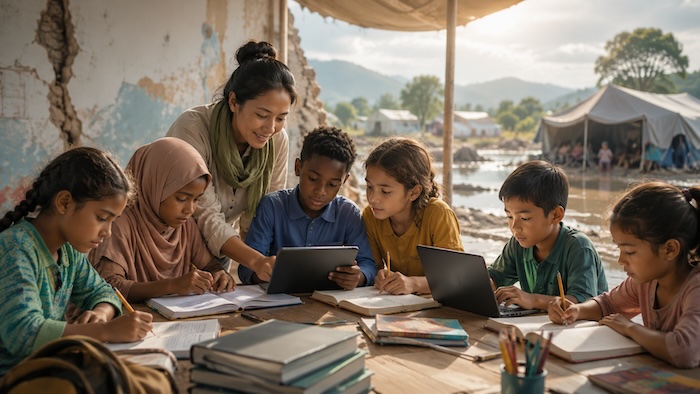
Around the world, millions of children are losing access to education—not for one reason, but because of a growing combination of armed conflict, displacement, restrictions on access, climate disruption, and declining international support. Protecting the right to education requires us to rethink not only how we protect schools, but how we keep learning alive when traditional education systems are disrupted.
Education is a fundamental human right. Yet for millions of children, that right remains beyond reach. A child cannot exercise the right to education when it is unsafe to reach school, when teachers cannot teach, when schools have been damaged or closed, or when the resources required to maintain education disappear.
Attacks on Education Are Increasing
The scale of attacks on education is particularly troubling. According to the Global Coalition to Protect Education from Attack’s Education Under Attack 2026, at least 8,566 attacks on education were recorded during 2024 and 2025, representing an increase of more than 40 percent compared with 2022–2023. At least 10,600 school and university students, teachers, professors, and other education personnel were harmed during the two-year period. More than 3,000 attacks on schools were documented, making schools the most prevalent category affected. Education Under Attack 2026 — GCPEA
The consequences extend well beyond damaged buildings. Schools give children structure, interaction with teachers and peers, and access to other essential services. When education disappears, an important part of the social infrastructure supporting children disappears with it.
At the Same Time, Education Funding Is Declining
This crisis is unfolding while international financial support for education is moving in the opposite direction. According to UNESCO’s latest Global Education Monitoring data, international aid to education declined by approximately 8 percent between 2023 and 2024, while aid specifically to basic education fell by approximately 15 percent. Education’s share of sector-allocable international aid fell to 7.5 percent—its lowest level in two decades. UNESCO Global Education Monitoring — Education Finance
The outlook is even more concerning. UNESCO now projects that global aid to education could decline by as much as 30 percent between 2023 and 2027. Low- and lower-middle-income countries have already lost approximately 21 percent of the education-aid levels they were receiving in 2023. UNESCO — July 2026 Education Financing Update
UNICEF reaches a similarly concerning conclusion through a separate analysis. It projects that Official Development Assistance for education could decline by $3.2 billion, or 24 percent, by 2026. If announced reductions materialize, UNICEF estimates that approximately 6 million additional children could be out of school by the end of 2026, about 30 percent of them in humanitarian settings. That would increase the estimated global number of out-of-school children from approximately 272 million to 278 million.
UNICEF further estimates that reductions in teacher development, curriculum, learning assessment, and education-system strengthening could negatively affect education quality for at least 290 million students. UNICEF — Education Aid Cuts: A Broken Promise to Children
The UNESCO and UNICEF estimates use different methodologies and time periods and should not be added together. However, both independently point toward a significant contraction in international education financing.
Different Crises Require Different Responses
Global statistics can hide an important reality: children lose access to education for very different reasons.
In Ukraine, armed conflict continues to damage educational infrastructure and interrupt schooling. UNICEF reported in November 2025 that 1,611 schools had been damaged or destroyed since February 2022, based on UN-verified incidents, while warning that the actual total may be higher. UNICEF — Education in Ukraine
In the Gaza Strip, prolonged conflict has produced educational disruption on a different scale. As of April 30, 2026, UNICEF reported that approximately 700,000 children ages 4–17 had missed formal in-person schooling for almost three consecutive school years. Nearly 98 percent of school buildings were damaged, more than 93 percent required major rehabilitation or complete reconstruction, and approximately 81 percent had been directly hit. UNICEF — State of Palestine Education Situation Update
In Sudan, armed conflict, displacement, insecurity, and damaged infrastructure have combined to create another type of education emergency. UNICEF reported in 2026 that more than 8 million children remained out of school, with especially severe disruption in Darfur and conflict-affected areas of Kordofan. UNICEF Sudan — May 2026 Humanitarian Situation Report
In Afghanistan, the principal barrier for millions of girls is different. In January 2026, UNESCO and UNICEF reported that Afghanistan remained the only country in the world where secondary and higher education are prohibited for girls and women, leaving approximately 2.2 million adolescent girls excluded from secondary education. UNESCO and UNICEF — Right to Education in Afghanistan
And Bangladesh illustrates another growing threat: climate-related disruption. UNICEF estimates that 35 million children in Bangladesh experienced schooling disruptions caused by extreme weather during 2024, including heatwaves, cyclones, and flooding. Some children lost as much as eight weeks of learning. UNICEF Bangladesh — Climate-Related School Disruption
Bangladesh is part of a much larger global pattern. UNICEF estimates that at least 242 million students across 85 countries or territories experienced school disruptions caused by extreme climate events during 2024, including heatwaves, tropical cyclones, storms, floods, and droughts. UNICEF — Learning Interrupted: Global Snapshot 2024
These situations are dramatically different. Their solutions must be different as well.
Technology Can Help Extend Scarce Resources
Protecting education first means protecting learners, educators, schools, and universities while maintaining adequate investment in education. But it must also mean preparing for circumstances in which conventional education systems cannot operate normally. Technology can become one part of that strategy.
A smartphone, inexpensive tablet, downloadable lesson, offline digital platform, community learning hub, or AI-supported learning environment cannot replace a functioning school and qualified teachers. UNESCO’s Technology in Education Global Education Monitoring Report specifically recommends that digital technology support education based on human interaction rather than attempt to substitute for it. UNESCO — Technology in Education: A Tool on Whose Terms?
At the same time, there is evidence that technology can extend educational access when conventional systems are interrupted. UNICEF’s Learning Passport, for example, is designed to function across public schools, community centers, refugee camps, homes, and offline or low-bandwidth environments. In 2025, UNICEF reported using the platform to support education continuity for crisis-affected and displaced learners in countries including Bangladesh, Lebanon, Poland, Sudan, and Syria. UNICEF Learning Passport — 2025 Annual Report
Technology should not become an excuse to reduce education funding. It should become a means of making limited resources reach further when circumstances demand it.
We Need Surgical Solutions, Not One Universal Answer
The appropriate solution for children displaced by war may be different from the solution required after a flood. A country facing teacher shortages requires a different intervention from a community where schools have been physically destroyed. Children excluded by policy face a different barrier from children who simply live too far from a functioning school.
The goal should therefore be surgical: identify precisely what prevents a learner from accessing quality education and assemble the most effective combination of teachers, communities, content, infrastructure, funding, and technology to overcome that barrier.
Education is too important to depend entirely on ideal circumstances. If we truly believe education is a human right, our responsibility cannot end with defending schools and advocating for greater funding.
We must also develop ways to ensure that learning continues when the traditional system cannot.