Texas is one of the fastest-growing and most economically powerful states in the country. New companies, new jobs, and new families continue to move here because of the opportunity Texas offers.
But a recent report from Texas 2036 and the George W. Bush Institute raises an important question: are Texas students prepared to fully participate in that opportunity?
The report, The State of Readiness, defines readiness as having the skills and knowledge needed to succeed in the next step—whether that is the next grade, college, career training, military service, or the workforce. By that definition, student readiness is not something that begins in high school. It starts in the early grades, when students build the reading, math, confidence, and learning habits that shape their future success.
The Readiness Gap Starts Early
One of the report’s most important findings is that students who fall behind early often struggle to catch up. According to the report, 93% of students who are not on grade level in third grade are still not on grade level by fifth grade.
That matters because early reading and math skills are the foundation for almost everything that follows. A student who struggles to read in elementary school may later struggle to access science, social studies, career pathways, and advanced coursework. A student who falls behind in math may face barriers in middle school, high school, and future career training.
Readiness is not just about passing a test. It is about giving students the foundation they need to choose their own future.
STAAR Data Shows Where Support Is Needed
The report points to STAAR as one of the tools Texas uses to understand whether students are on track. STAAR results help show where students are meeting grade-level expectations and where additional support may be needed.
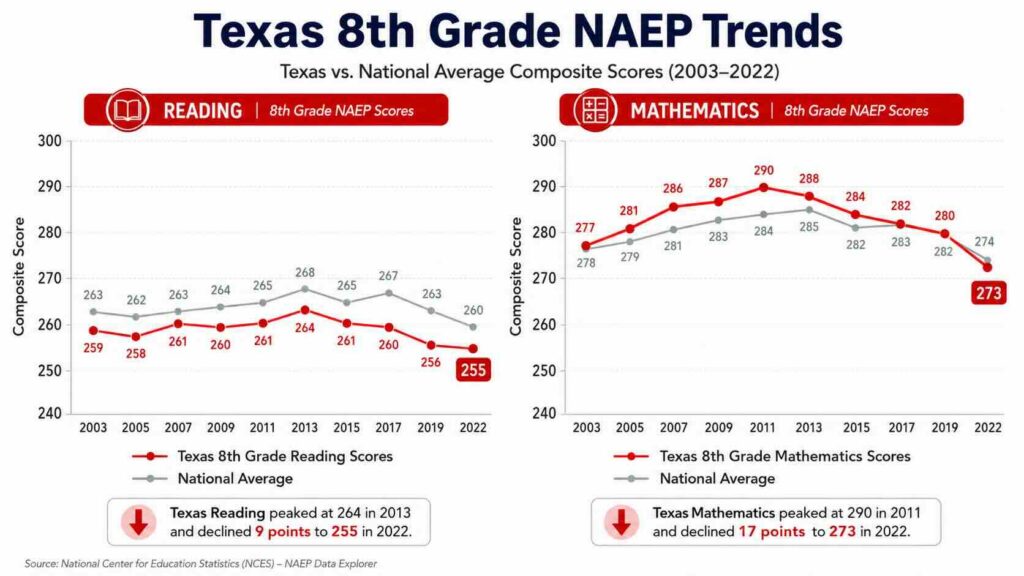
The data summarized in the report is concerning. It notes that 60% of Texas students are not doing math on grade level, and 48% are not reading on grade level. The results are even lower for students living in poverty, as well as for many Black and Hispanic students.
For high-need campuses, these numbers are more than statistics. They reflect students who may need more time, more practice, stronger academic support, and more confidence-building opportunities to stay engaged in school.
Readiness Is About More Than Graduation
Texas has a strong economy, but the report warns that too many young Texans may not be prepared to compete in that economy. By 2036, more than 70% of jobs in Texas are expected to require some form of postsecondary credential. Yet the report states that only 22% of Texas eighth-graders currently earn a postsecondary degree or credential within six years of high school graduation.
This means that the path to readiness cannot wait until senior year. Students need support much earlier—before learning gaps become long-term barriers.
Why Learning Recovery Matters
Learning recovery is often discussed in response to pandemic-related learning loss, but the challenge is broader than that. Many students were already behind before the pandemic. The report makes clear that Texas must take readiness seriously at every stage of a student’s education.
For schools, this means identifying learning gaps early and providing targeted support. For communities, it means helping schools access the resources, technology, volunteers, and partnerships that can expand what is possible for students.
Effective learning recovery should help students:
- rebuild foundational reading and math skills;
- strengthen confidence and academic habits;
- engage with learning in manageable steps;
- receive targeted practice where they need it most;
- stay on track for future coursework, graduation, and life after high school.
How IUME Foundation Responds
IUME Foundation’s work is rooted in a simple belief: quality learning should be within reach for every child.
Through programs such as the Texas Campus Growth & Learning Recovery Program and the Student Readiness Program, the Foundation works with schools, educators, volunteers, technology providers, and community partners to support students who may need additional help to catch up, grow, and thrive.
The goal is not to replace teachers or add more burden to school staff. The goal is to bring additional support to campuses that are working hard to close learning gaps and prepare students for long-term success.
A Shared Responsibility
The State of Readiness report makes one thing clear: Texas’ future prosperity depends on whether today’s students are prepared for tomorrow’s opportunities.
That responsibility cannot fall on schools alone. It requires families, educators, nonprofits, businesses, volunteers, and community partners working together to ensure that students—especially those in high-need communities—receive the support they need.
When students are ready, they have more choices. When students have more choices, they have a better chance to build the future they deserve.
At IUME Foundation, we believe every child deserves that chance.